Compound profile · Recovery research

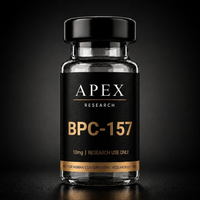
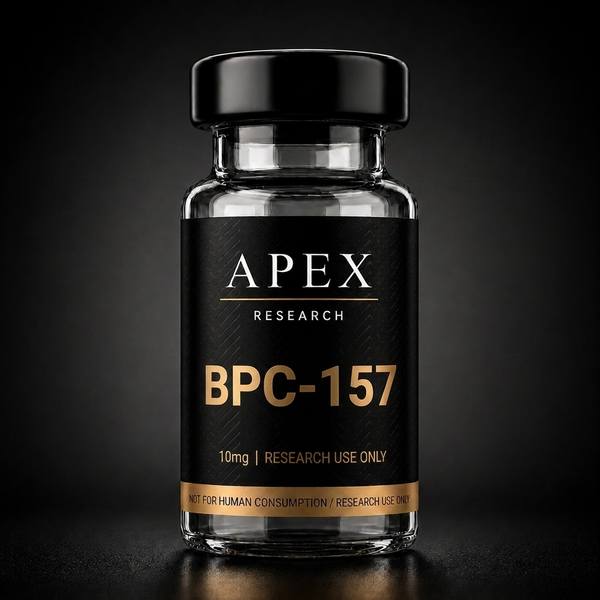
BPC-157

Body Protection Compound-157. A 15-amino-acid fragment of a protective protein found in the stomach, studied for tendon, ligament, muscle, joint and gut repair.

Recovery research 3rd Party Lab Verified
Purity99.61% (HPLC)
ClassBody-protection compound
StatusResearch compound · not FDA-approved
BPC-157
BPC-157
Dhs. 300.00
Shop now
01

A healing signal from the gut.

Your stomach makes a protein that helps protect and repair its own lining. BPC-157 is a short, 15-amino-acid piece of that protein, made in a lab.

01
Repair signal.
In research it helps grow new small blood vessels into damaged tissue, bringing oxygen and nutrients to places that heal slowly, like tendons and ligaments.
02
Repair cells & collagen.
It helps repair cells move to the injury and supports collagen, the material tissue is rebuilt from.
03
Survives stomach acid.
Unusual for a peptide, and the reason it has also been studied for gut problems.
Primary structure
Gly-Glu-Pro-Pro-Pro-Gly-Lys-Pro-Ala-Asp-Asp-Ala-Gly-Leu-Val
C62 H98 N16 O22 · 1,419.5 g/mol
Calculate your reconstitution dosage →
03

What's in the vial

Reference figures describe how this compound is handled and dosed in research. These are not instructions for human use.

Composition
Full nameBody Protection Compound-157
Amount10 mg labelled (9.25 mg measured, HPLC)
FormWhite freeze-dried powder
Specification
Purity99.61% (independent HPLC)
Molecular weight1,419.5 g/mol
CAS137525-51-0
04

At a glance

15
Amino acids
<30 min
Half-life
137525-51-0
CAS
99.61%
Purity (HPLC)
05

A short chain, a broad reach.

Hundreds of animal studies over 30 years, with consistent results across tendon, muscle, bone and gut. Human studies so far are small reports and pilot trials.

Its proposed mechanism is pleiotropic rather than single-target: nitric-oxide modulation, growth-factor receptor interaction, and influence on pathways tied to angiogenesis and cell migration. That breadth is part of why effects appear across many tissue models, and part of why mechanism is still debated.

06

Reading the evidence honestly

Not every claim made about BPC-157 carries equal weight. Apex Academy separates findings into three tiers based on how well-replicated and how directly applicable to humans the underlying research actually is.

Tier 01 - Strongest support
Strong in animal studies
  • Tendon and ligament injuries: torn Achilles tendons and knee ligaments healed faster and stronger across many studies
  • Muscle and bone: faster repair of crushed and torn muscle, better muscle-to-bone reattachment, faster bone healing
  • Gut: protected and healed stomach ulcers, colitis, and damage from NSAIDs and alcohol
Tier 02 · Early data
Promising, less established
  • Joint pain: in a small group of people with long-term knee pain, most reported relief after knee injections; small and uncontrolled
  • Human data overall limited to small reports and pilot trials
Tier 03 · Emerging / unverified
Speculative, not established
  • Systemic anti-ageing claims
  • Human dose-response and long-term safety data
  • Oral bioavailability comparisons versus injection in humans
07

How it works

Research has examined several distinct signalling pathways, summarised below.

01
Angiogenesis

Promotes endothelial tube formation via VEGFR2 in cell models.

In vitro / strong
02
Nitric-oxide axis

Interacts with the NO system implicated in vascular and gut protection.

Preclinical
03
Growth-factor crosstalk

Associated with EGR-1 and growth-factor signalling at wound sites.

Animal models
04
Gut integrity

Repeatedly protective against induced GI lesions in rodent studies.

Replicated (animal)
08

How it moves through the system

AdministrationPeakHalf-lifeCleared
Peak 50% Cleared
Minutes
Onset to peak
<30 min
Half-life
~4 h
Largely cleared
It leaves the blood fast, but the repair signals it switches on keep working for much longer. Curve shape is illustrative.
09

Used in the lab, not the clinic

Reference figures describe how this compound is handled and dosed in research. These are not instructions for human use.

Format & handling
Research formatLyophilised
ReconstitutionBacteriostatic water
Cold-chainRecommended
In the literature
Doses in literatureµg/kg (animal)
Storage2–8 °C; freezer long-term
Stability (reconstituted)28 days, refrigerated
010

Reconstitution calculator

How much diluent to mix into the vial, and the concentration that results: 1 mL gives 10 mg/mL, 2 mL gives 5 mg/mL (recommended), and 3 mL gives 3.33 mg/mL. Concentrations are based on the labelled 10 mg; the latest batch measured 9.25 mg by HPLC, giving about 4.63 mg/mL at 2 mL. These figures describe solution preparation for research handling, not instructions for use in humans or animals.

Suggested reconstitution Reconstitute the 10 mg vial with 2 mL bacteriostatic water → 5.0 mg/mL (5000 mcg/mL)
Concentration—
Volume / aliquot—
U-100 units—
Aliquots / vial—
Concentration = compound ÷ diluent. Volume per aliquot = target ÷ concentration. U-100 units are a volume readout (1 mL = 100 units). Figures are for research solution preparation only — not instructions for use in humans or animals.
011

Mixing with BAC water

BPC-157 arrives as a dry powder. Here's how to turn it into a ready-to-use solution. It takes about two minutes.

01
Get your kit ready.
BPC-157 vial, bacteriostatic water, a 3 mL mixing syringe and alcohol swabs. Let the vial reach room temperature.
02
Clean both tops.
Wipe the rubber stoppers of the BPC-157 vial and the water vial with an alcohol swab. Let them air dry.
03
Draw 2 mL of water.
Pull 2 mL of bacteriostatic water into the mixing syringe.
04
Add it slowly, down the glass.
Push the needle through the stopper at an angle and let the water run down the inside wall of the vial. Never spray it straight onto the powder.
05
Swirl, don't shake.
Gently roll the vial between your fingers until the powder is fully dissolved, usually under a minute. Shaking can damage the peptide.
06
Check, label, refrigerate.
It should be clear and colourless. Write the mixing date on the vial and keep it in the fridge. Use within 28 days.
012

Keep it cold

Peptides break down with heat, light and time. Store it right and every vial stays as strong as the first.

01
Before mixing: fridge, 2 - 8 °C.
Stays good until the expiry date on the vial. For storage beyond a few months, the freezer (−20 °C) is fine.
02
After mixing: 28 days.
In the fridge at 2–8 °C, upright and away from light. Put it back in the fridge right after each use.
03
Never freeze it mixed.
Don't freeze a mixed vial, and don't leave it in a hot car or direct sun. If it has been left warm, throw it away.
013

What the research flags

Adverse effects and open safety questions noted in published sources and reports. This is information, not guidance for use.

Injection-site reactions Reported
Redness, itch, a small bump or bruise at the site.
Nausea, headache or dizziness Occasional
Nausea is mild and usually in the first days; headache or dizziness is reported shortly after administration.
Tiredness or mood changes Occasional / rare
Tiredness is reported early on; mood changes (irritability, low motivation, brain fog) are rare.
Limited human data Research status
Human studies so far are small reports and pilot trials.
014

Signs of a quality compound

Lyophilised cake or powder
A solid white cake or fine powder at the bottom of the vial.
Clear reconstitution
Dissolves fully within a minute of gentle swirling into a clear, colourless solution with no bits floating.
Batch-specific COA
An independent HPLC report carrying the lab's own reference number, so it can be verified directly with the lab.
Intact seal & vacuum
Intact seal and stopper, with the vial still under vacuum.
Walk away if…
The powder is yellow, brown, clumped or shrunken; the mixed solution turns cloudy or shows particles; it was frozen after mixing or left out of the fridge; or it's more than 28 days since mixing.
Suspiciously cheap
Pricing far below the market for a well-tested compound usually means testing was skipped.
015

Tested by an independent lab

Every Apex batch is sent to an independent third-party lab before it's sold.

Independent lab tested
Every batch tested, latest result below
Latest result Report MR-040926-175 · 11 Sep 2026
Compound Purity Measured amount
BPC-157 99.61% 9.25 mg
Tested by Middle East Testing Services (METS), Ajman, UAE · HPLC
PurityHPLC · every batch must pass ≥99%
AmountHPLC · measures the mg in each vial

Each report carries the lab's own reference number, so you can verify it directly with the lab.

View full lab report
Regulatory & status
From gray market to formal review.

The FDA placed BPC-157 in Category 2 of the 503A bulks list in 2023, reflecting safety concerns centred on immunogenicity and impurities. It was removed from Category 2 in April 2026, but was not moved to Category 1. In July 2026 an FDA advisory committee voted 8–6 to recommend adding it to the compounding list, overruling FDA staff scientists. The recommendation is non-binding and would need formal rulemaking. BPC-157 remains an unapproved compound, sold only as a research material.

Status
Investigational research compound
2026 shift
Off Category 2; advisory panel recommended listing (non-binding)
Approval
Not FDA-approved for human use
Anti-doping
Prohibited in sport (WADA-listed)
Research handling
Storage2 - 8 °C before mixing
Reconstituted28 days at 2–8 °C
FormatWhite lyophilised powder
ReconstitutionBacteriostatic water
Important notices
  • For research purposes only
  • Not for human consumption
  • Not FDA approved
  • Not for use with cancer or a history of it
  • Not for use in pregnancy or breastfeeding
  • Prohibited in drug-tested sport (WADA)
  • Consult a qualified professional
Important

For research use only. Not for human consumption. Apex Academy is an educational reference describing findings reported in published and preclinical literature. Nothing here is medical advice, a protocol, or a recommendation to administer any compound to humans or animals. Many compounds described are investigational and are not approved by the FDA or other regulators for the prevention, treatment, or cure of any condition. Their long-term safety and pharmacokinetics remain incompletely characterized. Dose ranges, where shown, describe quantities used in cited research models - not instructions for use. Consult a qualified, licensed professional before making any health decision.