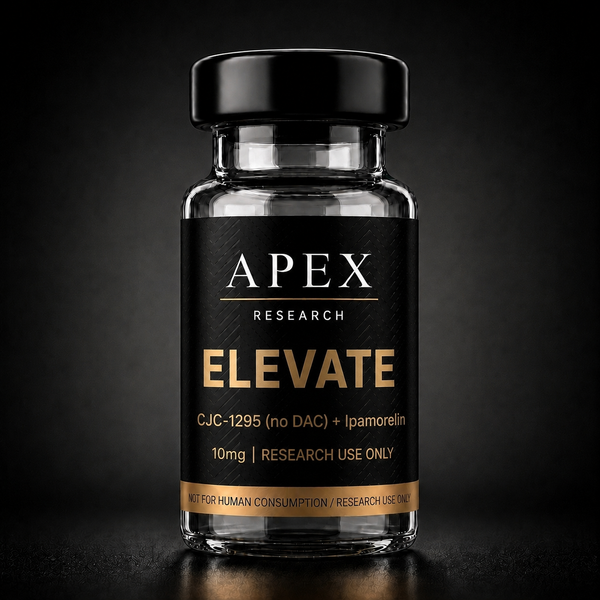
Products on this website are not intended to diagnose, treat, or cure any medical condition or disease. All products are sold strictly for laboratory and in-vitro research purposes — not for human or animal consumption.
These products are not medicines or drugs and have not been approved by the FDA or any other regulatory authority to prevent, treat, diagnose, mitigate, or cure any disease, ailment, or medical condition.
Every order ships with its certificate of analysis. For laboratory research use only.
↑↓ navigate↵ openTab completeFor laboratory research use only
Item added to your cart
Shop by
All products are supplied for laboratory and in-vitro research only. Not for human or animal use. 21+ only.
I
Compound profile · Recovery research
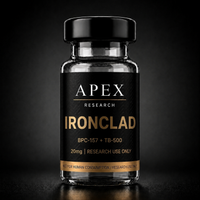
IRONCLAD
Apex's recovery blend of BPC-157 and TB-500, pre-mixed 1:1 in one vial. In research, BPC-157 acts at the injury site, while TB-500 helps repair cells move there from across the body.
IRONCLAD pairs BPC-157 with TB-500. Together they cover both halves of healing studied in research: repair where the injury is, and the cells to carry it out.
01
BPC-157
A 15-amino-acid piece of a protective protein from the stomach. In research it grows new small blood vessels into damaged tissue, bringing oxygen and nutrients to places that heal slowly, like tendons and ligaments.
02
TB-500
A lab-made piece of thymosin beta-4, a protein found in almost every cell. Its main role is letting repair cells move, so it acts across the whole body rather than one spot.
The two compounds act through different, complementary routes.
01
New blood vessels
BPC-157 grows new small blood vessels into damaged tissue.
BPC-157 · animal models
02
Cell migration
TB-500 lets repair cells move, via actin regulation.
TB-500 · animal models
03
Local + body-wide
BPC-157 acts at the injury site; TB-500 works across the whole body.
Research models
04
Inflammation
Both calm inflammation in injured tissue.
Animal studies
08
How it moves through the system
AdministrationPeakHalf-lifeCleared
Minutes
Onset to peak
30 min – 2 h
Half-life
~6 h
Largely cleared
BPC-157 clears within hours; TB-500 lingers longer in tissue. The repair signals both switch on keep working after that. Curve shape is illustrative.
09
Reconstitution calculator
How much diluent to mix into the vial, and the concentration that results. The suggested volume reaches a clean working stock; the calculator does the arithmetic from figures you enter. These describe solution preparation for research handling — not instructions for use in humans or animals.
Suggested reconstitutionReconstitute the 20 mg vial with 2 mL bacteriostatic water → 10.0 mg/mL (10000 mcg/mL)
Concentration—
Volume / aliquot—
U-100 units—
Aliquots / vial—
How much diluent to mix into the vial, and the concentration that results: 1 mL gives 20 mg/mL, 2 mL gives 10 mg/mL (recommended), and 3 mL gives 6.67 mg/mL. Figures are combined; at 2 mL that's 5 mg/mL of each compound based on the labelled amounts. The latest batch measured 10.44 mg BPC-157 and 11.42 mg TB-500 by HPLC. These figures describe solution preparation for research handling, not instructions for use in humans or animals.
010
Mixing with BAC water
IRONCLAD arrives as a dry powder. Here's how to turn it into a ready-to-use solution. It takes about two minutes.
01
Get your kit ready.
IRONCLAD vial, bacteriostatic water, a 3 mL mixing syringe and alcohol swabs. Let the vial reach room temperature.
02
Clean both tops.
Wipe the rubber stoppers of the IRONCLAD vial and the water vial with an alcohol swab. Let them air dry.
03
Draw 2 mL of water.
Pull 2 mL of bacteriostatic water into the mixing syringe.
04
Add it slowly, down the glass.
Push the needle through the stopper at an angle and let the water run down the inside wall of the vial. Never spray it straight onto the powder.
05
Swirl, don't shake.
Gently roll the vial between your fingers until the powder is fully dissolved, usually under a minute.
06
Check, label, refrigerate.
It should be clear and colourless. Write the mixing date on the vial and keep it in the fridge. Use within 28 days.
011
Keep it cold
Peptides break down with heat, light and time. Store it right and every vial stays as strong as the first.
01
Before mixing: fridge, 2 - 8 °C.
Stays good until the expiry date on the vial. For storage beyond a few months, the freezer (−20 °C) is fine.
02
After mixing: 28 days.
In the fridge at 2 - 8 °C, upright and away from light. Put it back in the fridge right after each use.
03
Never freeze it mixed.
Don't freeze a mixed vial, and don't leave it in a hot car or direct sun. If it has been left warm, throw it away.
04
Add it slowly, down the glass.
Push the needle through the stopper at an angle and let the water run down the inside wall of the vial. Never spray it straight onto the powder.
05
Swirl, don't shake.
Gently roll the vial between your fingers until the powder is fully dissolved, usually under a minute.
06
Check, label, refrigerate.
It should be clear and colourless. Write the mixing date on the vial and keep it in the fridge. Use within 28 days.
012
What the research flags
Adverse effects and open safety questions noted in published sources and reports. This is information, not guidance for use.
Injection-site reactionsCommon
Redness, itch, a small bump or bruise at the site.
Tiredness or head rushOccasional
Reported shortly after administration, early on.
Headache or nauseaOccasional
Headache in the first few days; mild nausea early on.
Combination not trialledResearch status
Human studies of each compound are small, and the blend itself hasn't been studied.
013
Signs of a quality compound
Lyophilised cake or powder
A solid white cake or fine powder at the bottom of the vial.
Clear reconstitution
Dissolves fully within a minute of gentle swirling into a clear, colourless solution with no bits floating.
Batch-specific COA
An independent HPLC report testing each compound separately, carrying the lab's own reference number.
Intact seal & vacuum
Intact seal and stopper, with the vial still under vacuum.
Walk away if…
The powder is yellow, brown, clumped or shrunken; the mixed solution turns cloudy or shows particles; it was frozen after mixing or left out of the fridge; or it's more than 28 days since mixing.
Suspiciously cheap
Pricing far below the market for a well-tested compound usually means testing was skipped.
014
Tested by an independent lab
Every Apex batch is sent to an independent third-party lab before it's sold.
Independent lab tested
Every batch tested, latest result below
Latest resultReport MR-040926-177 · 11 Sep 2026
Compound
Purity
Measured amount
BPC-157 / TB-500
99.86% / 99.58%
10.44 / 11.42 mg
Tested by Middle East Testing Services (METS), Ajman, UAE · HPLC
IRONCLAD combines two investigational research compounds. Neither is FDA-approved, and both are prohibited in sport. In April 2026 the FDA removed both BPC-157 and TB-500 from Category 2 but did not move them to Category 1. In July 2026 an FDA advisory committee voted to recommend both for the compounding list. The vote is not an approval, the FDA isn't bound by it, and any change would need formal rulemaking. See the individual BPC-157 and TB-500 profiles for the full evidence.